Why Are Entrepreneurs So Engaged? Research Paper
Abstract
Entrepreneurial personality has been shown to robustly predict work engagement, but the motivational mechanisms underlying this relationship remain unclear. Vision, a future- oriented facet of the Measure of Entrepreneurial Tendencies and Abilities (META) reflecting tendencies toward value creation and impact, has emerged a strong personality-level predictor of engagement among entrepreneurs. Drawing on Self-Determination Theory, we examined whether this relationship operates through intrinsic goal prioritisation, an orientation theorised to facilitate basic psychological need satisfaction and engagement. This mediation model was tested in a geographically diverse sample of 222 entrepreneurs using structural equation modelling, with relative intrinsic goal prioritisation operationalised across three rating dimensions: importance, likelihood, and attainment. Results demonstrated that Vision was strongly associated with work engagement and positively related to well-being, income and perceived venture progress. However, Vision was associated with greater relative extrinsic goal prioritisation, goal content was unrelated to engagement and the proposed mediation was not supported. These findings suggest that in entrepreneurial contexts, goal content and regulatory style may diverge, such that engagement may depend less on the type of goals pursued and more on the extent to which they are experienced as meaningful and self-endorsed. The present study contributes to process-oriented accounts of personality and highlights hope, challenge appraisal and meaningful activity as theoretically grounded avenues for future investigation.
1. Introduction
1.1 Work Engagement
Work engagement has become a central construct in organisational psychology and is increasingly emphasised in public discourse. For example, Bloomberg recently described it as ‘key to business success’, citing estimates that a fully engaged global workforce could generate up to $9.6 trillion in additional productivity (Gallup, 2025). Yet fundamental questions about what drives and sustains engagement remain unresolved. A substantial body of research documents who tends to be engaged, consistently showing that entrepreneurs report higher engagement than employees despite operating under greater demands and uncertainty (Dijkhuizen et al., 2016; Obschonka et al., 2019). Yet this work falls short of explaining how some entrepreneurs sustain higher levels of engagement than others, and through which psychological processes engagement is maintained. The present study speaks to this question by examining the motivational mechanisms through which Vision, a future- oriented entrepreneurial personality facet, relates to sustained work engagement among entrepreneurs. Specifically, we propose that visionary individuals may remain more engaged due to the fact they are dispositionally inclined to prioritise intrinsic over extrinsic goals, a motivational orientation linked to psychological need satisfaction within Self Determination Theory (Bradshaw et al., 2023; Ryan & Deci, 2017).
In professional contexts, the interest regarding engagement has coalesced around the construct of work engagement, a concept that has attracted substantial scientific attention.
Work engagement refers to a positive, fulfilling, work-related state of mind characterised by vigour (high levels of energy and resilience), dedication (strong involvement), and absorption (full concentration and immersion in one's work) (Schaufeli et al., 2002). A substantial body of research links work engagement to a range of desirable outcomes, including job performance (e.g., productivity, quality ratings) and favourable work attitudes, greater career satisfaction and higher subjective well-being within and outside of work (Corbaneanu et al., 2023;Kyoo Ju & Lee, 2017). With high relevance to both organisational and individual outcomes, understanding what drives and sustains engagement remains an important and practically meaningful pursuit.
One group that appears especially engaged are entrepreneurs. Rather paradoxically, while typically working longer hours and experiencing greater uncertainty and stress, entrepreneurs exhibit higher engagement than employees. This pattern is robust across studies operationalising entrepreneurship as self-employment or business ownership, even after controlling for demographic and job-related factors (Dijkhuizen et al., 2016; Bujacz et al., 2017; Gorgievski et al., 2010). Yet, while differences between entrepreneurs and employees are well established, comparatively little research has examined variation within the entrepreneurial population. The limited evidence available suggests that factors such as entrepreneurial passion, job resources and risk-taking may be associated with work engagement amongst entrepreneurs (e.g., Zhao et al., 2021; Mäkiniemi et al., 2021; Obschonka et al., 2019). However, such constructs may be constrained by their temporal instability. For instance, passion for a venture may fluctuate across different stages of the business, and job resources may vary depending on situational context. As such, predictors grounded in these factors may show varying predictive validity over time. This indicates the
value of shifting toward more stable individual characteristics that could more reliably differentiate entrepreneurs.
One way to capture more stable differences is through personality traits. Unlike situational or occupational factors, personality traits reflect relatively stable characteristics that travel with individuals across contexts, shaping how one typically approaches, interprets and invests in their work (McAdams, 2001). Given this stability and their demonstrated predictive utility across a wide range of work-related outcomes (Ozer & Benet-Martínez, 2006), personality traits may be better placed than other factors to explain why some individuals sustain high engagement, independent of context or position.
Two broad approaches to personality can be distinguished. First, broad personality frameworks, such as the Big Five (Openness, Conscientiousness, Extraversion, Agreeableness, Neuroticism; McCrae & Costa, 1992), capture general dispositional tendencies that predict behaviour across a wide range of contexts (Church et al., 2008). Alternatively, narrower trait frameworks focus on domain-specific traits, tailored to particular behavioural domains and may offer more precise predictions for specialised outcomes (Paunonen & Ashton, 2001). For example, narrower facets such as achievement striving and orderliness have been shown to predict a range of outcomes, including academic performance, health behaviours and social participation with greater precision than broader frameworks, while also demonstrating incremental validity beyond broader traits such as the Big Five (Komarraju et al., 2011; Paunonen & Ashton, 2001; De Vries et al., 2010). Hence, to predict specialised outcomes such as work engagement it may be more appropriate to focus on narrower, domain-relevant traits.
One example of a narrower, domain-specific trait framework is The Measure of Entrepreneurial Tendencies and Abilities, conceptualising entrepreneurial personality across four core facets: Creativity, Opportunism, Proactivity and Vision (Ahmetoglu, 2015). These dimensions reflect enduring motivational and behavioural orientations that shape how individuals recognise opportunities, initiate action and pursue future-oriented goals. META has demonstrated incremental validity over the Big Five and other established individual difference constructs including Vocational Interests, Trait Emotional Intelligence and Core Self-Evaluations, in predicting entrepreneurial outcomes (Leutner et al., 2014; Almeida et al., 2014) . Hence, this measure is well suited for examining individual differences in entrepreneurial contexts.
Indeed, META predicts work engagement well, with Vision emerging as the strongest predictor of its four facets (Ahmetoglu et al., 2021). Vision represents a future-oriented facet, reflecting tendencies toward value creation and impact, assessed through items such as ‘I can usually spot opportunities to create value’ and ‘I often think about how to make a positive difference’. However, while Vision has emerged as a strong predictor of work engagement, the psychological mechanisms through which this relationship operates remain to our knowledge unexplored, limiting our understanding of how some entrepreneurs stay more engaged than others.
More broadly, considerably less research examines why personality characteristics relate to engagement, that is the psychological processes through which these predictors exert their effects. Understanding these mechanisms is of great importance, as McAdams (2001) argues, ‘it is not personality in itself that predicts performance, but rather the enactment of personality’ (p. 174). From this perspective, personality traits do not directly produce outcomes but instead influence outcomes through the behaviours and psychological processes they give rise to. This distinction matters practically, as the processes through which traits operate may be more amenable to intervention than the traits themselves. Accordingly, process-oriented research seeks to elucidate how personality traits translate into outcomes through systematic motivational and behavioural pathways (Hampson, 2012). Thus, examining the psychological processes that allow some entrepreneurs to maintain higher engagement than others, may also help advance process-based personality research.
There has been relatively little, albeit emerging research elucidating the mechanisms underlying engagement. For example, research within the Job Demands–Resources (JD-R) framework demonstrates how job resources (eg., skill variety) predict work engagement by fostering learning and growth, which in turn engages employees (Mazzetti et al., 2023). Extending this, Xanthopoulou et al. (2007) demonstrated that job resources predict engagement indirectly, by first enhancing personal resources such as self-efficacy and optimism, which in turn predict engagement. Although not focused on personality per se, this work illustrates how environmental characteristics translate into engagement through intervening psychological processes, thereby clarifying not only that resources predict engagement but how they do so.
Extending this mechanistic approach to personality traits specifically, Bakker et al. (2012) demonstrated that proactive personality predicts engagement partly through job crafting behaviours. Employees with proactive personalities actively shape their work environment by increasing their social resources through feedback and support, enhancing their structural resources like skill development, and increasing job challenges such as job responsibilities. In this way, proactive personality operates through behaviours which create work conditions that are resourceful and challenging thereby fostering higher levels of work engagement. This work highlights the importance of examining not only which traits predict engagement but also the processes through which they operate, offering more practical avenues for fostering engagement.
However, mechanistic investigations of this kind remain limited. To our knowledge, no research has examined the motivational processes through which Vision relates to engagement among entrepreneurs. Without such insight, explanations of why Vision predicts engagement remain incomplete. Examining how visionary individuals sustain engagement and the processes underpinning this relationship may help identify how engagement can be more broadly enhanced, by targeting the mechanisms through which this trait operates.
1.2 Vision and Self Determination Theory
With our aim to elucidate the mechanisms underlying Vision's relationship with engagement, we first consider how its defining features may manifest. Vision reflects a future-oriented tendency towards value creation and impact-driven outcomes. This indicates that individuals high in Vision may pursue goals not primarily for external recognition, expectations, contingencies, or material reward, but because such goals are experienced as personally meaningful and worthwhile. Thus, visionary individuals may be more inclined to pursue self- generated goals aligned with what they render valuable. Such self-direction suggests that the motivation of visionary individuals is likely to be experienced as volitional and self-endorsed, rather than externally controlled.
One theoretically plausible account of this motivational profile is provided by Self- Determination Theory (SDT; Ryan & Deci, 2000). SDT proposes that sustained motivation, well-being and optimal functioning depend on the satisfaction of three basic psychological needs: autonomy (experiencing volition and self-endorsement), competence (feeling effective and capable), and relatedness (meaningful connection with others). Central to SDT is the distinction between autonomous motivation, arising when behaviour is experienced as volitional, self-endorsed and guided by personal values, and controlled motivation, which stems from external pressures or the pursuit of rewards and approval (Deci & Ryan, 2000). Critically, autonomous motivation is theorised to be more conducive to psychological need satisfaction, as it more naturally supports feelings of autonomy, competence and relatedness. To our interest, a substantial body of work demonstrates that need satisfaction supports work engagement and well-being whereas need frustration leads to ill-being (Van den Broeck et al., 2008; Xu et al., 2022; Bradshaw et al., 2023). Within this framework, Vision’s alignment with autonomous regulation through its emphasis on self-endorsed and personally meaningful pursuits, suggests that visionary individuals may be particularly likely to express the need- satisfying, motivational processes that SDT identifies as supportive of sustained engagement.
One way this expression could occur is through goal setting. A defining feature of autonomous motivation is the tendency to select goals that are personally meaningful and value-aligned, such that goals become integrated into the individual's value system rather than adopted for external rewards (Sheldon & Kasser, 2008). Within SDT, Goal Content Theory distinguishes between intrinsic goals centered around personal growth, meaningful
contribution, close relationships and health, and extrinsic goals, centered around wealth, fame and image. Intrinsic goals are posited to be directly supportive of the three basic psychological needs, as they are pursued for their inherent value and experienced as self- endorsed and meaningful. In contrast, extrinsic goals focus on externally contingent indicators of worth, making them less directly supportive of basic needs. It is the relative prioritisation of intrinsic over extrinsic goals (termed ‘relative intrinsicality’) that is considered central to psychological need satisfaction, with substantial evidence linking this orientation to well-being, vitality and importantly, to sustained work engagement (Erhlich, 2019; Kasser & Ryan, 1996; Sheldon & Krieger, 2014; Bradshaw et al., 2023). Considering Vision's emphasis on self-endorsed, value-driven tendencies and its alignment with autonomous regulation, visionary individuals may be particularly inclined to prioritise intrinsic over extrinsic goals.
Beyond motivational regulation, the substantive content of Vision may also align more naturally with intrinsic than extrinsic goal pursuits. For example, Vision's emphasis on impact and value creation aligns closely with intrinsic goal content. Vision items such as ‘My idea of success is to create progress in the world’ reflect a motivational orientation toward meaningful value and making a difference. This aligns with intrinsic aspirations such as ‘At the end of my life, to be able to look back on my life as meaningful and complete,’ both emphasising purpose, contribution and meaning. Indeed, individuals with stronger needs for meaning are more likely to endorse intrinsic aspirations centred on growth and contribution (Fiorito et al., 2021), and those with a stronger sense of purpose report higher intrinsic motivation (Kim et al., 2021). Accordingly, insofar as Vision reflects an orientation toward meaningful impact and value, it may naturally lead to individuals who prioritise intrinsic goals which centred on growth and purpose.
A similar alignment emerges when considering Vision’s defining future orientation. Vision items such as 'I spend a lot of time planning my future’ reflect a focus on long-term outcomes and lasting value. This temporal orientation maps conceptually onto intrinsic goals, which similarly emphasise enduring personal growth and sustained meaning. Some empirical support for this overlap comes from research on future time perspective, which refers to the extent to which individuals consider and plan for distant future outcomes. Research suggests that future-oriented individuals tend to prioritise emotionally meaningful goals such as generativity, close relationships and community contribution, and may exhibit greater prosocial generosity when benefits accrue over longer time horizons (Lang & Carstensen, 2002; Lu et al., 2023). Accordingly, Vision’s future focus may predispose individuals toward intrinsic goals, which tend to be centred on lasting impact and meaningful contribution.
In essence, Vision's defining features: value creation, impact-driven motivation and future orientation, align more naturally with growth-centred intrinsic aspirations than with externally contingent goals focused on wealth, fame or social image. Accordingly, individuals higher in Vision may be more likely to prioritise intrinsic over extrinsic goals. This pattern of relative intrinsicality could in turn, foster basic psychological need satisfaction and sustained work engagement.
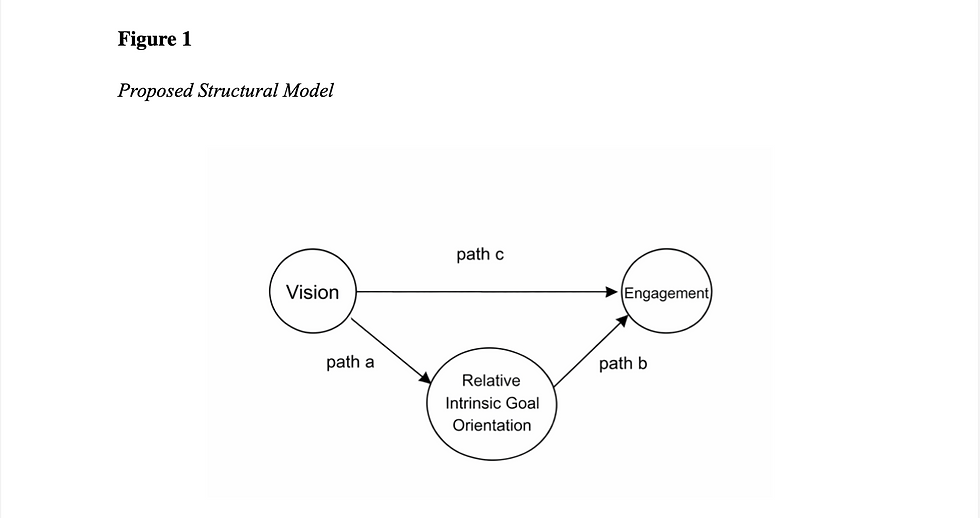
Despite these motivational and conceptual overlaps, no research to our knowledge has examined the relationship between Vision, intrinsic goals and engagement, nor tested Vision within the framework of SDT. Nonetheless, to address the gap in our understanding as to how Vision translates into engagement, SDT offers a promising explanatory framework. We propose that visionary individuals may remain more engaged because they are more likely to prioritise intrinsic over extrinsic goals, in other words, to exhibit greater relative intrinsicality in their goal profiles. As discussed visionary individuals should, by virtue of their disposition, be inclined to set goals in this way. As a consequence of this relative prioritisation, visionary individuals may experience greater satisfaction of their basic psychological needs and in turn, be more engaged. In this light, relatively higher intrinsic goal setting offers a plausible mechanistic explanation for why visionary entrepreneurs appear to be more engaged than others and could elucidate why Vision is such a strong predictor of engagement.
Table 1 presents our hypotheses. See Figure 1 for visual representation of the hypothesised model.

In addition to the primary hypotheses, the study also examines associations between Vision and a broader set of relevant variables. These analyses are intended to further characterise the nomological network of Vision and to provide additional evidence for its predictive validity, and are not relevant to the primary mediation model.
2. Methods
2.1 Measures
Work Engagement
Work engagement was assessed using the Utrecht Work Engagement Scale – Short Form (UWES-9; Schaufeli, Bakker, & Salanova, 2006). The UWES-9 is a nine-item self-report measure designed to capture a positive, work-related motivational state, conceptualised as comprising three components: vigour, dedication and absorption. Vigour refers to high levels of energy and resilience at work (3 items; e.g., feeling energetic while working), dedication reflects enthusiasm and a sense of personal significance (3 items; e.g., feeling inspired by one’s work), and absorption reflects deep concentration and immersion in work tasks (3 items; e.g., becoming fully engrossed in work activities). Responses were recorded on a 7- point Likert scale ranging from 0 (never) to 6 (always).
The UWES-9 is a condensed version of the original 17-item Utrecht Work Engagement Scale (Schaufeli et al., 2002), developed to provide a more parsimonious assessment. Previous research has demonstrated good reliability, factorial validity and cross-cultural robustness of the short form (e.g., Schaufeli et al., 2006; Shimazu et al., 2008). The UWES-9 has also been employed in prior research examining entrepreneurial personality and engagement, in which the three engagement facets were specified as indicators of a single latent engagement construct (e.g., Ahmetoglu et al., 2015).
In the present study, internal consistency for the Engagement scale was good (Cronbach’s α = .92). Consistent with prior research, engagement was treated as a latent construct indicated by vigour, dedication and absorption in our main analyses.
Intrinsic Goals
The Aspiration Index (AI; Kasser & Ryan, 1993, 1996, 2001) developed within Self- Determination Theory was used to assess individuals’ life goals. The Aspiration Index operationalises goal contents as aspirations framed as life goals, distinguishing between intrinsic aspirations and extrinsic aspirations. The full measure comprises 35 life goals, organised into six core aspiration domains: three intrinsic (personal growth, relationships, community contribution) and three extrinsic (wealth, fame, image). Each life goal is presented as a brief statement e.g., ‘To grow and learn new things’ (intrinsic) and ‘To have enough money to buy everything I want’ (extrinsic). Participants are asked to rate each goal on three dimensions: how important the goal is to them personally (importance), how likely they believe they are to attain it (likelihood), and the extent to which they have already attained it (attainment). Responses are provided on a 7-point Likert scale ranging from low to high endorsement.
Intrinsic and extrinsic aspiration scores were computed by averaging responses within their respective domains. A relative intrinsic goal orientation index was then calculated for each domain by subtracting extrinsic aspiration scores from intrinsic aspiration scores, following established scoring procedures. Positive values indicate greater relative emphasis on intrinsic over extrinsic aspirations, while negative values indicate greater relative emphasis on extrinsic over intrinsic aspirations. All subsequent analyses used these relative intrinsicality scores across the three dimensions (importance, likelihood and attainment).
The Aspiration Index has been widely used in empirical research and has demonstrated strong reliability, construct validity and cross-cultural robustness across age groups and contexts (e.g., Kasser & Ryan, 1993, 1996; Ryan et al., 1999; Schmuck et al., 1999).
Vision
Vision was assessed using the Vision facet of the Measure of Entrepreneurial Tendency and Ability (META; Ahmetoglu et al., 2015). Vision reflects a future-oriented, impact-focused motivational orientation, encompassing (a) future orientation (e.g., ‘I never look back’) , (b) a desire to create impact and value beyond the self (e.g., ‘My goal in life is to create something that transforms people's lives’), which also relates to prosocial orientation and (c) achievement striving (e.g., ‘I have a strong desire to be successful in life’). Participants rated their agreement with each item on a 5-point Likert scale ranging from 1 (completely disagree) to 5 (completely agree). The Vision scale demonstrated good internal consistency (Cronbach’s α = .90).
Supplementary Measures
Separate from the main hypotheses, three additional outcome measures income, positive affect and perceived venture progress were included to examine Vision’s associations with a wider range of entrepreneurial and well-being outcomes. Vision has received comparatively less empirical attention than other widely studied personality constructs. These additional measures were therefore included to explore Vision’s predictive utility across a broader set of entrepreneurial and well-being outcomes.
Income was measured via self-reported annual pre-tax earnings, ranging from £0 to £300,000+ (M = £46,112.61).
Positive affect was assessed using the Positive and Negative Affect Schedule (PANAS; Watson et al., 1988). Participants rated the extent to which they experienced a range of positive emotions (e.g., interested, excited, enthusiastic) on a 5-point Likert scale. Items were averaged to form a composite positive affect score, with higher values indicating greater positive affect. The PANAS has demonstrated strong reliability and validity across diverse samples. This measure demonstrated good internal consistency (Cronbach’s α = .91).
To indicate venture success we used the perceived venture progress measure, a four-item scale adapted from established measures of personal goal progress (Brunstein, 1993) and tailored to the new venture context (Uy et al., 2015; Koller, Ahmetoglu, & Stephan, 2025), for example ‘I am satisfied with the progress I have made concerning my venture’. These items were rated on a 5-point Likert scale ranging from 1 (strongly disagree) to 5 (strongly agree). This measure demonstrated good internal consistency (Cronbach’s α = .92)
2.2 Participants
An a priori power analysis indicated that a minimum sample size of 200 participants was required to detect the smallest anticipated effect size (.25) with a power of .80. In total, 350 participants were recruited via opportunity sampling through the online research platform Prolific. Inclusion and quality-control criteria were applied, including a maximum survey completion time of 45 minutes as an attention check, and confirmation that participants were founders who currently managed at least one aspect of their venture. After applying these criteria, the final sample consisted of 222 participants aged between 20 and 75 years (M = 37.39, SD = 12.18). The sample included 100 females (45.5%), 121 males (54.4%), and one participant who did not disclose their gender. In regard to the country of residence of our participants, the sample was geographically diverse. Nearly half of participants were based in South Africa (45.5%), followed by the United States (12.6%) and the United Kingdom (9.5%). Smaller proportions resided in Canada (5.9%), Kenya (5.4%), and Portugal (5.0%), with the remaining participants distributed across a wide range of countries, including Australia, Brazil, France, Mexico, India, Japan, and several European nations, representing less than 3% of the sample. The study received ethical approval from the UCL Department of Clinical, Educational and Health Psychology. All participants provided informed consent prior to participation.
2.3 Procedure
Participants took part voluntarily in an online survey administered via Prolific Academic, an established online participant recruitment platform widely used in entrepreneurship research (Koller et al., 2025; Peer, 2024). Participants were compensated at a standard rate of £6.50 per hour for completing the questionnaire.
At the start of the survey, participants were presented with an information sheet outlining the purpose of the study, data confidentiality and their rights as participants, and were required to provide informed consent before proceeding. Participants first completed demographic and biographical questions relating to their occupational status, work activities (e.g., hours worked, number of employees in their venture), and achievements.
They then completed a series of questionnaires assessing the study variables. All items were mandatory, and participants were required to respond to each question before advancing to the next. The survey took approximately 25 minutes to complete. Upon completion, the data were downloaded from Prolific and stored as a CSV file for analysis.
2.4 Data Analysis
All statistical analyses were carried out in RStudio using R version 4.3.1 (R Core Team, 2020; RStudio Team, 2020).
To evaluate the measurement properties of the key constructs (Vision and Engagement), exploratory factor analysis (EFA) was first conducted to determine the number of factors supported by the data. Confirmatory factor analysis (CFA) was then used to test theoretically specified measurement models and assess how well the observed items represented their intended latent constructs, as well as how well our items loaded onto their respective constructs. Factor loadings were evaluated using conventional criteria. Loadings greater than .30 and statistically significant at p ≤ .05 were considered meaningful and retained in the analyses.
Work engagement was operationalised in two ways across analyses. In the structural equation modelling (SEM) analyses, engagement was specified as a single latent factor indicated by the nine items of UWES-9. A unidimensional representation of the UWES-9 has been supported in prior studies (Fong & Ng, 2011; Vallières et al., 2016), and this latent specification was therefore used within the SEM framework. In the linear regression and bivariate correlation analyses, engagement was operationalised using observed composite scores across its three domains (vigour, dedication and absorption) consistent with the
conceptualisation of engagement proposed by Schaufeli, Bakker, and Salanova (2006). Here, mean scores were computed separately for vigour, dedication, and absorption, and these facets were examined independently.
SEM was subsequently used to test the study hypotheses to examine the relationships between Vision, engagement, and the mediating role of relative intrinsic orientation. SEM specifically was used to account for measurement error and to model our latent variables at the construct level rather than at the facet level.
Age and gender were included as control variables in all structural equation models to account for potential demographic influences on the primary study variables.
3. Results
3.1 Correlations
Descriptive statistics and bivariate correlations among the study variables are presented in Table 2. Additional Pearson correlations revealed that within each rating dimension, intrinsic and extrinsic goal scores were positively correlated: importance (r = .48), likelihood (r = .67), and attainment (r = .72), all ps < .001. Collapsing across dimensions, intrinsic and extrinsic goals were also positively correlated overall, r(220) = .65, p < .001, 95% CI [.57, .72].

Note: Vision refers to the Vision facet of the META measure. Vigour, dedication, and absorption represent the three dimensions of work engagement. Positive affect (PA) reflects mean scores on the PANAS positive affect items. PVS denotes perceived venture success. Income reflects standardised self-reported annual income. RI Importance, RI Likelihood, and RI Attainment refer to relative intrinsic goal importance, likelihood, and attainment, respectively. Correlations are Pearson product– moment correlations computed from standardised scale scores. Descriptive statistics (M and SD) are based on raw, unstandardised scores. p < .05, * p < .01, *** p < .001.
3.2 Factor Analysis
An EFA and scree plot indicated a one-factor solution for the Vision scale. A CFA revealed that Item 3 had a non-significant loading (λ = .10, p = .151) and was excluded from all subsequent analyses. All remaining items loaded significantly onto a single Vision latent factor (λ = .18–.76, all ps < .01) used in SEM.
An EFA and CFA of the nine engagement items indicated a single-factor solution, and engagement was modelled as a single latent factor in SEM (λ = .43–.93, all ps < .001). A separate CFA specifying the three-factor structure (vigour, dedication, absorption; Schaufeli et al., 2002) was conducted for subscale-level analyses, with all items loading significantly onto their respective factors (all ps < .001; vigour: λ = .72–.80; dedication: λ = .85–.93; absorption: λ = .43–.71). These subscales were used in regression and bivariate correlation analyses.
Internal consistency was satisfactory across all measures (all αs > .70; George & Mallery, 2003).
Given high intercorrelations among goal domains, CFAs tested whether intrinsic and extrinsic items were better represented by a single goal factor or three factors reflecting the three rating dimensions (importance, likelihood and attainment). The three-factor model fit significantly better in both cases (extrinsic: Δχ2(3) = 1042.30, p < .001; intrinsic: Δχ2(3) = 1473.50, p < .001), though absolute fit remained poor (extrinsic: CFI = .68, TLI = .66, RMSEA = .13, SRMR = .09; intrinsic: CFI = .54, TLI = .52, RMSEA = .12, SRMR = .11). This may reflect high intercorrelations among the three rating dimensions rather than model
misspecification. Reliability was strong across each rating dimension, with high internal consistency for both intrinsic (α = .92–.95) and extrinsic goals (α = .95–.96). Consistent with established scoring practice, goals were retained as separate composites for each dimension and relative intrinsic scores were subsequently computed across each dimension (Bradshaw et al., 2023).
3.3 Structural Equation Models
Across all three models, the latent Vision factor was specified as an exogenous predictor of the relevant relative intrinsic goal orientation and of engagement. Engagement was modelled as a single latent factor indicated by all its nine items.
Relative Intrinsic Goal Importance as Mediator
Model fit: χ2(431) = 1058.37, p < .001, CFI = .82, TLI = .80, RMSEA = .09, 90% CI [.08, .10], SRMR = .07. Vision was negatively associated with relative intrinsic goal importance (β = −.25, SE = .09, p < .001), and relative intrinsic goal importance did not significantly predict engagement (β = .08, SE = .06, p = .146). The direct path from Vision to engagement remained significant when relative intrinsic goal importance was included (β = .67, SE = .11, p < .001), indicating no mediation. The indirect effect of Vision on engagement via relative intrinsic goal importance was non-significant (β_indirect = −.02, 95% CI [−.09, .01], p = .188), based on bootstrap standard errors. The model accounted for 6% of the variance in relative intrinsic goal importance and 43% of the variance in engagement (R2 = .06 and .47, respectively). See Figure 2.1.
Relative Intrinsic Goal Likelihood as Mediator
Model fit: χ2(431) = 1029.79, p < .001, CFI = .83, TLI = .81, RMSEA = .09, 90% CI [.08, .10], SRMR = .07. Vision was negatively associated with relative intrinsic goal likelihood (β = −.24, SE = .09, p = .001), and relative intrinsic goal likelihood did not significantly predict engagement (β = .11, SE = .06, p = .08). The direct path from Vision to engagement remained significant when relative intrinsic goal likelihood was included (β = .68, SE = .11, p < .001), indicating no mediation. The indirect effect of Vision on engagement via relative intrinsic goal likelihood was non-significant (β_indirect = −.03, 95% CI [−.09, .00], p = .089), based on bootstrap standard errors. The model accounted for 6% of the variance in relative intrinsic goal likelihood and 44% of the variance in engagement (R2 = .06 and .47, respectively). See Figure 2.2.
Relative Intrinsic Goal Attainment as Mediator
Model fit: χ2(431) = 992.40, p < .001, CFI = .83, TLI = .82, RMSEA = .09, 90% CI [.08, .09], SRMR = .07. Vision was not significantly associated with relative intrinsic goal attainment (β = −.03, SE = .09, p = .721), and relative intrinsic goal attainment did not significantly predict engagement (β = .10, SE = .06, p = .075). The direct path from Vision to engagement remained significant when relative intrinsic goal attainment was included (β = .66, SE = .11, p < .001), indicating no mediation. The indirect effect of Vision on engagement via relative intrinsic goal attainment was non-significant (β_indirect = −.003, 95% CI [−.03, .02], p = .729), based on bootstrap standard errors. The model accounted for less than 1% of the variance in relative intrinsic goal attainment and 44% of the variance in engagement (R2 ≈ .001 and .47, respectively). See Figure 2.3.

Note: Standardised path coefficients are shown. Paths marked with ’ were not statistically significant (p > .05). All other paths were significant (p < .05).
3.4. Supplementary Analyses
Independent of the primary hypothesis tests, supplementary linear regressions were conducted to examine Vision's predictive relationships with well-being, income and perceived venture progress. A visualisation of these relationships is presented in Figure 3.
Vision significantly predicted well-being, F(1, 220) = 165.90, p < .001, R2 = .43, β = .66; income, F(1, 220) = 7.74, p = .006, R2 = .03, β = .18; and perceived venture progress, F(1, 220) = 94.87, p < .001, R2 = .30, β = .55. A higher Vision score was associated with higher scores on each outcome.
Figure 3
Scatterplot illustrating standardised relationships between Vision and Income, Perceived Venture Progress, and Positive Affect (Well-being).

4. Discussion
Prior research has established Vision as a strong predictor of work engagement amongst entrepreneurs (Ahmetoglu et al., 2021). The present study tested whether intrinsic goal prioritisation, across importance, likelihood and attainment domains, mediates the relationship between Vision and engagement. Drawing on SDT (Kasser & Ryan, 1996), we hypothesised that Vision predicts intrinsic goal prioritisation, which in turn predicts engagement via basic need satisfaction. Contrary to these hypotheses, Vision instead predicted greater extrinsic goal prioritisation across the importance and likelihood domains, goal prioritisation was unrelated to engagement and the mediation between Vision and engagement by goal orientation, was not supported.
4.2 Vision and Work Engagement
Consistent with prior research (Ahmetoglu et al., 2021), Vision strongly predicted work engagement, replicating this association within a geographically diverse entrepreneurial sample spanning multiple countries, ages and income levels. Vision accounted for a substantial proportion of variance in engagement in our sample, supporting the view that narrow, domain-specific traits predict specialised outcomes with considerable precision (Paunonen & Ashton, 2001).
Theoretically, this relationship likely reflects a motivational alignment where individuals oriented toward future impact and value creation may be predisposed to invest sustained
energy and consistent activity into work that is personally valuable, thereby maintaining the vigour and absorption that characterises engagement.
4.3 Vision and Intrinsic Goals
The present results demonstrate that Vision was unrelated to intrinsic goal attainment and was instead associated with relative extrinsic goal importance and likelihood. The null association with attainment is to some extent, conceptually unsurprising. Vision reflects a future-oriented, aspirational disposition concerned with imagined possibilities and long-term impact, whereas goal attainment captures what has already been achieved. As such, attainment which reflects past achievement rather than future aspiration, may be less relevant to the forward-looking motivational orientation captured by Vision.
However, contrary to our hypothesis, Vision's emphasis on creating value and impact may not inherently privilege intrinsic over extrinsic goal content. Instead, it may be that being high in vision, renders a wide array of goals meaningful. Importantly, impact, value and meaning remain subjective constructs, and what constitutes meaningful impact may vary considerably across individuals. Financial success, for example, may enable resource deployment within a venture rather than reflecting a purely self-enhancing pursuit, and visibility reflected in items such as ‘to have my name known by many people’ (Aspiration Index; Kasser & Ryan, 1993) may amplify reach and effectiveness for prosocial impact, rendering such goals instrumentally valuable rather than ends in themselves. Therefore, it may be that for individuals high in Vision, extrinsic goals are understood as expressions of impact-driven motivation pursued in service of value creation.
Identified regulation, within SDT’s motivational continuum, offers a useful theoretical lens for understanding this pattern (Deci & Ryan, 2020). Although distinct from intrinsic motivation, identified regulation refers to engaging in goal pursuit because one personally endorses the value of the goal’s outcomes, experiencing it as self-congruent even if its pursuit is not inherently enjoyable. Visionary individuals oriented toward value creation, may be especially inclined toward this form of regulation, prioritising the broader purpose and consequences of their goals over the immediate experience of goal pursuit. In this sense, extrinsic goals may be pursued not for their external rewards per se, but because their outcomes align with identified values, for example wealth as a means of creating impact. Therefore, Vision as a trait may enable individuals to prioritise any personally meaningful goals, such that engagement is sustained irrespective of goal type.
4.4 Goal Setting and Engagement
Contrary to prior research (Erhlich, 2019), goal prioritisation was unrelated to engagement in our sample. One possible explanation concerns how entrepreneurs conceptualise goal content. The positive correlations observed between intrinsic and extrinsic goals suggest that in this sample, both goal types were pursued concurrently rather than as competing priorities. Entrepreneurs may therefore not meaningfully differentiate between intrinsic and extrinsic goals if both may serve their broader entrepreneurial aims. Indeed, we can see how financial success and improving people's lives for example, may both be central priorities in building and maintaining a successful venture. Within SDT, this pattern is consistent with integrated regulation whereby diverse goals, whether framed as financial, social or personal become assimilated into a broader entrepreneurial identity and life narrative (Deci & Ryan, 2020). When goals are experienced as expressions of who one is and what one's venture stands for, the distinction between intrinsic and extrinsic content may become psychologically less salient if they all serve the same overarching entrepreneurial project.
This pattern raises questions about the validity of the Aspiration Index in entrepreneurial contexts, where goals typically classified as extrinsic may be pursued alongside rather than in opposition to intrinsic goals. If intrinsic and extrinsic goals do not represent opposing motivational orientations, as they are often assumed to in employed populations, then relative goal prioritisation would not be expected to predict significantly differential outcomes. Difference scores rely on the assumption that the constructs being contrasted are oppositional; when they are positively correlated, the resulting index may contain little meaningful variance and is unlikely to predict outcomes. However, directly testing this interpretation would require comparison of goal content structures between entrepreneurial and employed samples.
One notable pattern warrants brief consideration. Extrinsic goal importance and likelihood were positively associated with well-being, contrary to meta-analytic evidence showing extrinsic goal prioritisation typically predicts lower well-being (Bradshaw et al., 2023). Extrinsic goals are typically proposed to undermine well-being because they fail to directly satisfy basic psychological needs. However, SDT recognises that extrinsic goals can become internalised such that they may satisfy needs when autonomously regulated (Ryan & Deci, 2000). Indeed research on entrepreneurial motivation demonstrates that financial success is frequently intertwined with autonomy and family security motives (Stephan et al., 2015), and qualitative evidence indicates that entrepreneurs often frame wealth as enabling independence and purpose-driven action rather than as an end in itself (Riitsalu et al., 2023). Thus, goals commonly classified as extrinsic may reflect internalised values pursued
autonomously in entrepreneurial contexts, offering a plausible account for their positive association with well-being in the present sample. However, if extrinsic goals were internalised and autonomously pursued in our sample, SDT predicts that they should also predict engagement through need satisfaction, which they did not. This divergence suggests that well-being and engagement may be supported by different psychological mechanisms in entrepreneurial samples.
Ultimately, our findings do suggest that the intrinsic–extrinsic goal distinction may be less psychologically meaningful in entrepreneurial contexts than SDT-based research typically assumes.
4.5 Vision to Engagement Mechanisms
The primary objective of this study was to elucidate the mechanisms underlying the association between Vision and work engagement, yet results suggest that this relationship is not mediated by intrinsic goal prioritisation. The subsequent section explores alternative theoretical processes or mechanisms that may explain this link.
First, we propose that visionary individuals may be predisposed to pursue meaningful work and that this tendency could be inherently need-satisfying. SDT posits that need satisfaction is the fundamental driver of optimal functioning, such that activities satisfying basic psychological needs may predict engagement independently of goal content (Van den Broeck et al., 2008). Individuals oriented toward value creation and meaningful impact, may be particularly inclined to engage in work experienced as meaningful and intrinsically valuable and thus, well positioned to satisfy all three basic needs. Indeed, work perceived as meaningful has been shown to satisfy basic psychological needs, and it follows that engaging in such work is likely to feel self-endorsed (supporting autonomy) contributory to others (supporting relatedness), and to some extent effective (supporting competence) (Martela & Riekki, 2018). Moreover, perceiving one’s activities as meaningful has been shown to enhance engagement independently of specific goal pursuit (Kusanova et al., 2021; May et al., 2004). Therefore, perhaps visionary individuals may not require intrinsic goal prioritisation for need satisfaction. A meaning centred orientation may instead support need satisfaction and sustain engagement independent of goal content.
Alternatively, the future-oriented nature of Vision may enable individuals high in Vision to remain engaged. This orientation reflects to some extent a belief in the attainability of valued outcomes and confidence in one’s capacity to identify and pursue pathways toward them, indicative of a hopeful orientation. Hope may be defined as the perceived ability to generate routes toward desired goals (pathways) and to motivate oneself to use those routes (agency) (Rand & Touza, 2018; Snyder’s Hope Theory, Snyder 2002). Within this framework individuals high in hope possess not only the energy to pursue goals but also the cognitive flexibility to generate alternative routes when obstacles arise, enabling sustained effort over time. Indeed, hope has been identified as a strong predictor of work engagement (Das & Borooah, 2025), operating through mechanisms such as persistence, effort investment, and energisation among individuals who believe they can achieve desired future outcomes. Perhaps, visionary individuals who consistently look to the future may be higher in hope. In turn, they may remain engaged by generating alternative routes to goals and maintaining persistence and effort over time, consistent with hope theory, which emphasises both pathway generation and agency.
Notably, this is a particularly compelling mechanism, given the substantial literature validating optimism as a predictor of engagement and entrepreneurial success, with which hopeful cognition shares considerable conceptual overlap (Keneally, 2020; Lindblom et al., 2020).
Finally, Vision may sustain engagement by shaping how entrepreneurial demands are cognitively appraised. According to Lazarus and Folkman's (1984) Transactional Model of Stress and Coping, the psychological impact of any demand depends not on its objective nature but on how it is subjectively interpreted. Specifically, whether it is appraised as a threat or as a challenge. Research distinguishes between challenge demands, appraised as growth-promoting, and hindrance demands, appraised as obstacles, with challenge appraisals robustly predicting work engagement (Crawford et al., 2010; Nair et al., 2020). Given Visionary individuals are likely to be especially oriented toward future impact and purposeful work, their energy and attention may be more focused on future outcomes rather than present hindrances. This may enable them to consider anticipated outcomes more heavily relative to present costs, such that current difficulty may be discounted against the anticipated value of what lies ahead, rendering current demands more tolerable and purposeful. Indeed, evidence suggests that future-oriented perspectives and a strong sense of purpose are associated with more positive, challenge-oriented appraisals of demands and reduced stress appraisals (Sutin et al., 2023; Hill et al., 2018; Raper & Brough, 2020).
Perhaps, it is when a clear vision of a valued future is at hand that present demands may feel less like arbitrary burdens. In this sense, Vision may not eliminate entrepreneurial strain but may provide a future-oriented interpretive framework that renders demands meaningful and manageable, representing a potential pathway through which it sustains engagement independent of goal content.
4.5 Limitations and Future Directions
Several limitations should be considered when interpreting the present findings. A first limitation concerns sample representativeness. Participants were recruited via Prolific Academic, an online platform where individuals participate in exchange for modest financial compensation. This recruitment method may have disproportionately attracted entrepreneurs experiencing financial constraints, for whom monetary incentives are particularly salient. Financially constrained entrepreneurs may exhibit goal profiles that are more extrinsically oriented than the broader entrepreneurial population. This may explain why Vision predicted greater extrinsic goal prioritisation in our sample, as immediate financial pressures may elevate the salience of wealth and income relative to intrinsic goals.
Additionally, perhaps goal pursuit may not have functioned as a source of need satisfaction at all, within this entrepreneurial sample in the way it typically does in other populations. Goal Content Theory proposes that intrinsic goals promote positive outcomes because they facilitate satisfaction of the basic psychological needs (Kasser & Ryan, 1996), if goal pursuit does not translate into need satisfaction, the expected relationship between goal content and engagement would be unlikely to emerge. Empirical evidence suggests that entrepreneurial demands such as financial strain, workload and uncertainty can frustrate basic psychological needs (Olafsen & Frølund, 2018; Shi et al., 2024), and although these pressures were not directly measured, entrepreneurs in the present sample may have experienced such frustration. This could have prevented intrinsic goals from functioning as need-satisfying pursuits, possibly weakening the mechanism through which intrinsic goal pursuit would typically translate into engagement. With this in mind, the proposed mediation pathway may not have been absent, but rather difficult to detect under conditions of need frustration. To address both limitations , future research should therefore recruit entrepreneurs through alternative channels such as entrepreneurial networks or incubators, sampling across a range of venture stages and financial circumstances, to examine whether the present findings generalise beyond these possibly resource constrained contexts.
Relatedly, basic psychological need satisfaction and frustration were only inferred rather than directly measured in the present study. We proposed that intrinsic goal prioritisation would predict engagement through the satisfaction of the needs for autonomy, competence and relatedness. However, without a direct measure of need satisfaction, we were unable to formally test whether Vision predicts engagement via need satisfaction, instead inferring this pathway from how goal content was assumed to manifest. This is a notable limitation, given that SDT research typically assesses need satisfaction directly rather than inferring it from goal endorsement (e.g., Church et al., 2013; Unanue et al., 2024). Future research could directly assess need satisfaction using established measures such as the Basic Psychological Need Satisfaction Scale (Deci & Ryan, 2000), and also address questions raised in the present study. For example, whether being visionary satisfies needs independently of goal content, and whether goal orientations reliably function as need-satisfying pursuits in entrepreneurial contexts.
Nonetheless, future research could further explore the patterns observed in the present study. In particular, to identify possible mechanistic explanations for the relationship between Vision and engagement, future studies could test the processes proposed such as hopeful orientations and pathway generation or challenge appraisals, as mediators. Such work may help to elucidate the processes that account for why visionary individuals appear to be so highly engaged.
Moreso, given that visionary individuals seemed to demonstrate relative extrinsicality in their goal orientation, it may be particularly valuable to examine how entrepreneurs conceptualise and internalise goals that appear extrinsic. Qualitative approaches could be useful to capture how entrepreneurs make sense of material goals within the broader pursuit of autonomy, independence or impact. Such work could help explain the somewhat unusual pattern observed here, where entrepreneurs who prioritise extrinsic goals also remain highly engaged, a pattern not typically aligned with SDT.
Lastly, given that Vision was a particularly strong predictor of engagement, future research could examine whether this trait can be strengthened through intervention. For example, experimental studies could investigate whether practices such as articulating long-term impact narratives, connecting daily tasks to broader value-creation goals, or mentorship programmes centred on purpose and legacy can increase entrepreneurial engagement over time.
4.6 Practical Implications
From an applied perspective, the findings highlight Vision as a robust and practically meaningful individual-differences predictor. Vision predicted work engagement, well-being, income and perceived venture success, supporting its validity across both entrepreneurial and non-entrepreneurial contexts. Practitioners and educators may therefore benefit from identifying and supporting visionary individuals or those oriented toward value creation and future-focused action. From a selection perspective, these findings also support the use of Vision as a reliable indicator of engagement potential in recruitment and role placement.
Finally, our findings may carry practical implications for those working with entrepreneurs. Visionary entrepreneurs tended to prioritise extrinsic goals. This indicates financial and material aspirations could form a meaningful part of their motivational landscape, and could be harnessed explicitly in coaching or programme design, for instance by framing venture milestones in terms of financial independence or tangible value creation. By contrast, highlighting particular goal contents may not be the most effective lever for supporting entrepreneurial engagement.
Conclusion
In the present study Vision emerged as a robust predictor of engagement. In seeking to understand the processes underlying this relationship, we tested whether intrinsic goal prioritisation mediated this effect, however our hypothesis was not supported. Vision was associated with extrinsic goal orientations and goal orientation was unrelated to engagement. Nonetheless our findings may be theoretically informative, suggesting that standard SDT assumptions regarding goal content and appraisal may operate differently in entrepreneurial contexts, where perhaps goal content and goal regulation may come apart in these individuals. Moreso, by contributing to process-oriented personality research, the present study adds to a growing and practically relevant body of work and highlights hope and challenge appraisals as promising avenues for future research in explaining the relationship between Vision and engagement. Unpacking what enables visionary entrepreneurs to remain highly engaged remains an open question, one that this study takes a step toward addressing.
References
Ahmetoglu, G. (2015). The entrepreneurial personality: A new framework and construct for entrepreneurship research and practice (Doctoral thesis, Goldsmiths, University of London).
Ahmetoglu, G., Harding, X., Akhtar, R., & Chamorro-Premuzic, T. (2015). Predictors of creative achievement: Assessing the impact of entrepreneurial potential, perfectionism, and employee engagement. Creativity Research Journal, 27(2), 198–205. https://doi.org/ 10.1080/10400419.2015.1030293
Ahmetoglu, G., Nefyodova, V., Chamorro-Premuzic, T., & Codreanu, S. (2020). What leads entrepreneurial employees to want to quit, or stay in, their job? Exploring two conflicting mechanisms. Applied Psychology, 70(2), 738–758. https://doi.org/10.1111/apps.12250
Al-Jubari, I., & Mosbah, A. (2019). Do intrinsic and extrinsic motivation relate to entrepreneurial intention differently? A Self-Determination Theory perspective. Academy of Entrepreneurship Journal, 25.
Almeida, P. I. L., Ahmetoglu, G., & Chamorro-Premuzic, T. (2014). Who wants to be an entrepreneur? The relationship between vocational interests and individual differences in entrepreneurship. Journal of Career Assessment, 22(1), 102–112.
Bakker, A. B., Tims, M., & Derks, D. (2012). Proactive personality and job performance: The role of job crafting and work engagement. Human Relations, 65(10), 1359–1378. https://doi.org/ 10.1177/0018726712453471
Block, J., & Sandner, P. (2009). Necessity and opportunity entrepreneurs and their duration in self- employment: Evidence from German micro data. Journal of Industry, Competition and Trade, 9(2), 117–137.
Bradshaw, E. L., Conigrave, J. H., Steward, B. A., Ferber, K. A., Parker, P. D., & Ryan, R. M. (2022). A meta-analysis of the dark side of the American dream: Evidence for the universal wellness costs of prioritizing extrinsic over intrinsic goals. Journal of Personality and Social Psychology, 124(4), 873–899. https://doi.org/10.1037/pspp0000431
Brunstein, J. C. (1993). Personal goals and subjective well-being: A longitudinal study. Journal of Personality and Social Psychology, 65(5), 1061–1070.
Bujacz, A., Bernhard-Oettel, C., Rigotti, T., & Lindfors, P. (2017). Task-level work engagement of self-employed and organizationally employed high-skilled workers. Career Development International, 22(6), 724–738. https://doi.org/10.1108/CDI-05-2016-0083
Church, A. T., Katigbak, M. S., Locke, K. D., Zhang, H., Shen, J., De Jesús Vargas-Flores, J., Ibáñez- Reyes, J., Tanaka-Matsumi, J., Curtis, G. J., Cabrera, H. F., Mastor, K. A., Alvarez, J. M., Ortiz, F. A., Simon, J. R., & Ching, C. M. (2013). Need satisfaction and well-being. Journal of Cross- Cultural Psychology, 44(4), 507–534. https://doi.org/10.1177/0022022112466590
Church, A. T., Katigbak, M. S., Reyes, J. A. S., Salanga, M. G. C., Miramontes, L. A., & Adams, N. B. (2008). Prediction and cross-situational consistency of daily behavior across cultures: Testing trait and cultural psychology perspectives. Journal of Research in Personality, 42(5), 1199–1215. https://doi.org/10.1016/j.jrp.2008.03.007
Corbeanu, A., & Iliescu, D. (2023). The link between work engagement and job performance. Journal of Personnel Psychology, 22(3), 111–122. https://doi.org/10.1027/1866-5888/a000316
Crawford, E. R., LePine, J. A., & Rich, B. L. (2010). Linking job demands and resources to employee engagement and burnout: A theoretical extension and meta-analytic test. Journal of Applied Psychology, 95(5), 834–848.
Daniels, K. (2006). Rethinking job characteristics in work stress research. Human Relations, 59(3), 267–290. https://doi.org/10.1177/0018726706064171
Das, P., & Borooah, I. P. (2025). The role of psychological capital in work engagement: A study of employees from a public sector bank in India. International Journal of Indian Psychology. https:// doi.org/10.25215/1302.385
De Vries, A., De Vries, R. E., & Born, M. P. (2011). Broad versus narrow traits: Conscientiousness and honesty–humility as predictors of academic criteria. European Journal of Personality, 25(5), 336–348. https://doi.org/10.1002/per.795
Deci, E. L., & Ryan, R. M. (2000). The 'what' and 'why' of goal pursuits: Human needs and the self- determination of behavior. Psychological Inquiry, 11(4), 227–268.
Deci, E. L., Ryan, R. M., & Gagné, M. (2000). Basic Psychological Need Satisfaction Scales (BPNSS). Self-Determination Theory. https://selfdeterminationtheory.org/basic-psychological- need-satisfaction-scales/
Dijkhuizen, J., Van Veldhoven, M., & Schalk, R. (2016). Four types of well-being among entrepreneurs and their relationships with business performance. The Journal of Entrepreneurship, 25(2), 184–210. https://doi.org/10.1177/0971355716650369
Duriez, B., Vansteenkiste, M., Soenens, B., & De Witte, H. (2007). The social costs of extrinsic relative to intrinsic goal pursuits: Their relation with social dominance and racial and ethnic prejudice. Journal of Personality, 75(4), 757–782. https://doi.org/10.1111/ j.1467-6494.2007.00456.x
Ehrlich, C. (2019). The relevance of identified and intrinsic goal motivation for work engagement. European Journal of Applied Positive Psychology, 3, Article 5. https:// www.nationalwellbeingservice.org/volumes/volume-3-2019/volume-3-article-5/
Fiorito, T., & Routledge, C. (2021). Meaning-motivated community action: The need for meaning and prosocial goals and behavior. Personality and Individual Differences, 171, Article 110462. https:// doi.org/10.1016/j.paid.2020.110462
Fong, T. C., & Ng, S. (2012). Measuring engagement at work: Validation of the Chinese version of the Utrecht Work Engagement Scale. International Journal of Behavioral Medicine, 19(3), 391–397. https://doi.org/10.1007/s12529-011-9173-6
Fukuzaki, T., & Iwata, N. (2022). Association between the five-factor model of personality and work engagement: A meta-analysis. Industrial Health, 60(2), 154–163. https://doi.org/10.2486/ indhealth.2021-0051
Gallup, Inc. (2021). State of the global workplace report. https://www.gallup.com/workplace/349484/ state-of-the-global-workplace.aspx
George, D., & Mallery, P. (2003). SPSS for Windows step by step: A simple guide and reference (4th ed.). Allyn & Bacon.
González-Romá, V., Schaufeli, W. B., Bakker, A. B., & Lloret, S. (2005). Burnout and work engagement: Independent factors or opposite poles? Journal of Vocational Behavior, 68(1), 165– 174. https://doi.org/10.1016/j.jvb.2005.01.003
Gorgievski, M. J., Bakker, A. B., & Schaufeli, W. B. (2010). Work engagement and workaholism: Comparing the self-employed and salaried employees. The Journal of Positive Psychology, 5(1), 83–96. https://doi.org/10.1080/17439760903509606
Grant, A. M. (2008). Does intrinsic motivation fuel the prosocial fire? Motivational synergy in predicting persistence, performance, and productivity. Journal of Applied Psychology, 93(1), 48– 58. https://doi.org/10.1037/0021-9010.93.1.48
Gupta, A., & Behl, A. (2025). Self-determination theory. In S. Papagiannidis (Ed.), TheoryHub Book. https://open.ncl.ac.uk/theory-library/self-determination-theory.pdf
Hafstad, M. D., Ebrahimi, O. V., & Fostervold, K. I. (2024). The dialectical relationship between burnout and work engagement: A network approach. Stress and Health, 41(2), e3514. https:// doi.org/10.1002/smi.3514
Hakanen, J. J., Ropponen, A., De Witte, H., & Schaufeli, W. B. (2019). Testing demands and resources as determinants of vitality among different employment contract groups: A study in 30 European countries. International Journal of Environmental Research and Public Health, 16(24), 4951. https://doi.org/10.3390/ijerph16244951
Hampson, S. E. (2012). Personality processes: Mechanisms by which personality traits 'get outside the skin.' Annual Review of Psychology, 63(1), 315–339. https://doi.org/10.1146/annurev- psych-120710-100419
Hill, P. L., Sin, N. L., Turiano, N. A., Burrow, A. L., & Almeida, D. M. (2018). Sense of purpose moderates the associations between daily stressors and daily well-being. Annals of Behavioral Medicine, 52(8), 724–729. https://doi.org/10.1093/abm/kax039
Kasser, T., & Ryan, R. M. (1993). A dark side of the American dream: Correlates of financial success as a central life aspiration. Journal of Personality and Social Psychology, 65(2), 410–422.
Kasser, T., & Ryan, R. M. (1996). Further examining the American dream: Differential correlates of intrinsic and extrinsic goals. Personality and Social Psychology Bulletin,
22(3), 280–287. https://doi.org/10.1177/0146167296223006Kenneally, C. (2020). The effects of optimism, transformational leadership, and work engagement on
work outcomes: A moderated mediation model [Master's thesis, Old Dominion University]. ODU
Digital Commons. https://digitalcommons.odu.edu/psychology_etds/346Khusanova, R., Kang, S., & Choi, S. B. (2021). Work engagement among public employees:
Antecedents and consequences. Frontiers in Psychology, 12, Article 684495. https://doi.org/ 10.3389/fpsyg.2021.684495
Kim, E. S., Strecher, V. J., & Ryff, C. D. (2014). Purpose in life and use of preventive health care services. Proceedings of the National Academy of Sciences, 111(46), 16331–16336.
Koller, S., Ahmetoglu, G., & Stephan, U. (2025). Measuring entrepreneurs' use of effectuation as heuristics: Development and validation of a situational judgment test (SJT) for effectuation. Journal of Business Venturing, 40(6). https://doi.org/10.1016/j.jbusvent.2025.06s
Komarraju, M., Karau, S. J., Schmeck, R. R., & Avdic, A. (2011). The Big Five personality traits, learning styles, and academic achievement. Personality and Individual Differences, 51(4), 472– 477.
Kyoo Ju, B., & Lee, I. (2017). Workplace happiness: Work engagement, career satisfaction, and subjective well-being. Evidence-based HRM, 5(2), 206–221.
Lang, F. R., & Carstensen, L. L. (2002). Time counts: Future time perspective, goals, and social relationships. Psychology and Aging, 17(1), 125–139. https://doi.org/10.1037/0882-7974.17.1.125
Lanivich, S. E., Bennett, A., Kessler, S. R., McIntyre, N., & Smith, A. W. (2020). RICH with well- being: An entrepreneurial mindset for thriving in early-stage entrepreneurship. Journal of Business Research, 124, 571–580. https://doi.org/10.1016/j.jbusres.2020.10.036
Lazarus, R. S., & Folkman, S. (1984). Stress, appraisal, and coping. Springer.Leutner, F., Ahmetoglu, G., Akhtar, R., & Chamorro-Premuzic, T. (2014). The relationship between
the entrepreneurial personality and the Big Five personality traits. Personality and Individual
Differences, 63, 58–63. https://doi.org/10.1016/j.paid.2014.01.042Levontin, L., & Bardi, A. (2019). Using personal values to understand the motivational basis of amity
goal orientation. Frontiers in Psychology, 9, Article 2736. https://doi.org/10.3389/
fpsyg.2018.02736Lindblom, A., Lindblom, T., & Wechtler, H. (2020). Dispositional optimism, entrepreneurial success
and exit intentions: The mediating effects of life satisfaction. Journal of Business Research, 120,
230–240. https://doi.org/10.1016/j.jbusres.2020.08.012Lu, J. G., Brockner, J., Vardi, Y., & Weitz, E. (2023). Prosocial behavior across time horizons. Journal
of Personality and Social Psychology, 124(4), 821–838.Martela, F., & Riekki, T. J. J. (2018). Autonomy, competence, relatedness, and beneficence: A
multicultural comparison of the four pathways to meaningful work. Frontiers in Psychology, 9, Article 1157.
Martela, F., Gómez, M., Unanue, W., Araya, S., Bravo, D., & Espejo, A. (2021). What makes work meaningful? Longitudinal evidence for the importance of autonomy and beneficence for meaningful work. Journal of Vocational Behavior, 131, Article 103631. https://doi.org/10.1016/ j.jvb.2021.103631
May, D. R., Gilson, R. L., & Harter, L. M. (2004). The psychological conditions of meaningfulness, safety and availability and the engagement of the human spirit at work. Journal of Occupational and Organizational Psychology, 77(1), 11–37. https://doi.org/10.1348/096317904322915892
Mazzetti, G., Robledo, E., Vignoli, M., Topa, G., Guglielmi, D., & Schaufeli, W. B. (2023). Work engagement: A meta-analysis using the Job Demands-Resources model. Psychological Reports, 126(3), 1069–1107. https://doi.org/10.1177/00332941211051988
McAdams, D. P. (2013). Actor, agent, and author. Perspectives on Psychological Science, 8(3), 272– 295. https://doi.org/10.1177/1745691612464657
McCrae, R. R., & John, O. P. (1992). An introduction to the Five-Factor model and its applications. Journal of Personality, 60(2), 175–215. https://doi.org/10.1111/j.1467-6494.1992.tb00970.x Mäkiniemi, J. P., Ahola, S., Nuutinen, S., Laitinen, J., & Oksanen, T. (2021). Factors associated with
job burnout, job satisfaction and work engagement among entrepreneurs: A systematic qualitative review. Journal of Small Business & Entrepreneurship, 33(2), 219–247. https://doi.org/ 10.1080/08276331.2020.1764735
Nair, A. V., McGregor, A., & Caputi, P. (2020). The impact of challenge and hindrance demands on burnout, work engagement, and presenteeism: A cross-sectional study using the Job Demands– Resources model. Journal of Occupational and Environmental Medicine, 62(8), e392–e397. https://doi.org/10.1097/jom.0000000000001908
Obschonka, M., Moeller, J., & Goethner, M. (2019). Entrepreneurial passion and personality: The case of a German innovator. Entrepreneurship Research Journal, 9(1).
Olafsen, A. H., & Frølund, C. W. (2018). Challenge accepted! Distinguishing between challenge- and hindrance demands. Journal of Managerial Psychology, 33(4/5), 345–357. https://doi.org/10.1108/ jmp-04-2017-0143
Ozer, D. J., & Benet-Martínez, V. (2006). Personality and the prediction of consequential outcomes. Annual Review of Psychology, 57, 401–421. https://doi.org/10.1146/ annurev.psych.57.102904.190127
Paunonen, S. V., & Ashton, M. C. (2001). Big five factors and facets and the prediction of behavior. Journal of Personality and Social Psychology, 81(3), 524–539.
Peer, E. (2024). Prolific: Crowdsourcing Academic Online Research. Cambridge University Press EBooks, 72–92. https://doi.org/10.1017/9781009000796.005
Poropat, A. E. (2009). A meta-analysis of the five-factor model of personality and academic performance. Psychological Bulletin, 135(2), 322–338.
Prieto-Díez, F., Postigo, Á., Cuesta, M., & Muñiz, J. (2022). Work engagement: Organizational attribute or personality trait? Journal of Work and Organizational Psychology, 38(2), 85–92. https://doi.org/10.5093/jwop2022a7
Rand, K. L., & Touza, K. K. (2021). Hope theory. In C. R. Snyder, S. J. Lopez, L. M. Edwards, & S. C. Marques (Eds.), The Oxford handbook of positive psychology (3rd ed.). Oxford University Press. https://doi.org/10.1093/oxfordhb/9780199396511.013.25
Raper, M. J., & Brough, P. (2021). Seeing into the future: The role of future-oriented coping and daily stress appraisal in relation to a future stressor. Stress and Health, 37(1), 186–197. https://doi.org/ 10.1002/smi.2984
Riitsalu, L., Sulg, R., Lindal, H., Remmik, M., & Vain, K. (2024). From security to freedom—The meaning of financial well-being changes with age. Journal of Family and Economic Issues, 45(1), 56–69. https://doi.org/10.1007/s10834-023-09886-z
Ryan, R. M., & Deci, E. L. (2000). Self-determination theory and the facilitation of intrinsic motivation, social development, and well-being. American Psychologist, 55(1), 68–78. https:// doi.org/10.1037/0003-066x.55.1.68
Ryan, R. M., & Deci, E. L. (2017). Self-determination theory: Basic psychological needs in motivation, development, and wellness. Guilford Press.
Ryan, R. M., & Deci, E. L. (2020). Intrinsic and extrinsic motivation from a self-determination theory perspective: Definitions, theory, practices, and future directions. Contemporary Educational Psychology, 61, Article 101860. https://doi.org/10.1016/j.cedpsych.2020.101860
Schaufeli, W. B., Bakker, A. B., & Salanova, M. (2006). The measurement of work engagement with a short questionnaire: A cross-national study. Educational and Psychological Measurement, 66(4), 701–716.
Schaufeli, W. B., Salanova, M., González-Romá, V., & Bakker, A. B. (2002). The measurement of engagement and burnout: A two sample confirmatory factor analytic approach. Journal of Happiness Studies, 3(1), 71–92.
Sheldon, K. M. (2014). Becoming oneself: The central role of self-concordant goal selection. Personality and Social Psychology Review, 18(4), 349–365. https://doi.org/ 10.1177/1088868314538549
Sheldon, K. M., & Kasser, T. (2008). Psychological threat and extrinsic goal striving. Motivation and Emotion, 32(1), 37–45.
Sheldon, K. M., & Krieger, L. S. (2014). Service job lawyers are happier than money job lawyers, despite their lower income. The Journal of Positive Psychology, 9(3), 219–226. https://doi.org/ 10.1080/17439760.2014.888583
Schmuck, P., Kasser, T., & Ryan, R. (1999). INTRINSIC AND EXTRINSIC GOALS: THEIR STRUCTURE AND RELATIONSHIP TO WELL-BEING. https://selfdeterminationtheory.org/ wp-content/uploads/2014/04/2000_SchmuckKasserRyan_SIR.pdf
Shi, H. (2024). The psychological mechanism of basic psychological need frustration affecting job burnout: A qualitative study from China. Frontiers in Psychology, 15, Article 1400441. https:// doi.org/10.3389/fpsyg.2024.1400441
Shir, N., Nikolaev, B. N., & Wincent, J. (2019). Entrepreneurship and well-being: The role of psychological autonomy, competence, and relatedness. Journal of Business Venturing, 34(5), Article 105875.
Snyder, C. R. (2002). Hope theory: Rainbows in the mind. Psychological Inquiry, 13(4), 249–275. Stephan, U. (2018). Entrepreneurs' mental health and well-being: A review and research agenda.
Academy of Management Perspectives, 32(3), 290–322.Stephan, U., & Roesler, U. (2010). Health of entrepreneurs versus employees in a national
representative sample. Journal of Occupational and Organizational Psychology, 83(3), 717–738. Stephan, U., Hart, M., Mickiewicz, T., & Drews, C.-C. (2015). Understanding motivations for
entrepreneurship: A review of recent research evidence. Department for Business, Innovation and
Skills & IFF Research.Stephan, U., Rauch, A., & Hatak, I. (2023). Happy entrepreneurs? Everywhere? A meta-analysis of
entrepreneurship and wellbeing. Entrepreneurship Theory and Practice, 47(2), 553–593.
Sutin, A. R., Luchetti, M., Stephan, Y., & Terracciano, A. (2021). Sense of purpose in life and motivation, barriers, and engagement in physical activity and sedentary behavior: Test of a mediational model. Journal of Health Psychology, 27(9), 2068–2078. https://doi.org/ 10.1177/13591053211021661
Sutin, A. R., Luchetti, M., Stephan, Y., Sesker, A. A., & Terracciano, A. (2023). Purpose in life, stress mindset, and perceived stress: Test of a mediational model. Personality and Individual Differences, 210, Article 112227. https://doi.org/10.1016/j.paid.2023.112227
Unanue, W., Martela, F., Vignoles, V. L., & Dittmar, H. (2023). Clarifying the link between psychological need satisfaction and positive affect: Longitudinal within-person tests for bi- directional influence in two cultures. European Journal of Personality, 089020702311571. https:// doi.org/10.1177/08902070231157149
Uy, M. A., Foo, M. D., & Ilies, R. (2015). Perceived progress variability and entrepreneurial effort intensity: The moderating role of venture goal commitment. Journal of Business Venturing, 30(3), 375–389.
Vallières, F., McAuliffe, E., Hyland, P., Galligan, M., & Ghee, A. (2017). Measuring work engagement among community health workers in Sierra Leone: Validating the Utrecht Work Engagement Scale. Journal of Work and Organizational Psychology, 33(1), 41–46. https://doi.org/ 10.1016/j.rpto.2016.12.001
Van den Broeck, A., Vansteenkiste, M., De Witte, H., & Lens, W. (2008). Explaining the relationships between job characteristics, burnout, and engagement: The role of basic psychological need satisfaction. Work & Stress, 22(3), 277–294. https://doi.org/10.1080/02678370802393672
Vansteenkiste, M., Lens, W., & Deci, E. L. (2006). Intrinsic versus extrinsic goal contents in self- determination theory: Another look at the quality of academic motivation. Educational Psychologist, 41(1), 19–31.
Warr, P., & Inceoglu, I. (2018). Work orientations, well-being and job content of self-employed and employed professionals. Work, Employment and Society, 32(2),
292–311. https://doi.org/10.1177/0950017017717684Watson, D., Clark, L. A., & Tellegen, A. (1988). Development and validation of brief measures of
positive and negative affect: The PANAS scales. Journal of Personality and Social Psychology, 54(6), 1063–1070. https://doi.org/10.1037/0022-3514.54.6.1063
Xanthopoulou, D., Bakker, A. B., Demerouti, E., & Schaufeli, W. B. (2007). The role of personal resources in the job demands-resources model. International Journal of Stress Management, 14(2), 121–141. https://doi.org/10.1037/1072-5245.14.2.121
Xu, L., Wang, Z., Li, Z., et al. (2022). Mediation role of work motivation and job satisfaction between work-related basic need satisfaction and work engagement among doctors in China: A cross- sectional study. BMJ Open, 12, Article e060599. https://doi.org/10.1136/bmjopen-2021-060599
Zhao, S., Zhou, Y., Guan, H., & Xu, W. (2021). Entrepreneurial passion psychology-based influencing factors of new venture performance. Frontiers in Psychology, 12, Article 696963. https://doi.org/ 10.3389/fpsyg.2021.696963

Comments